
Miami, FL · Miami-Dade County
Fire-Rated Joint & Penetration Affidavit
Certification that fire-rated materials and assemblies protecting building penetrations and joints comply with Florida Building Code and approved testing standards.
- Florida-licensed notary
- ~15 min average
- Notarized PDF emailed
What you’ll need
- Government-issued photo ID
- Webcam-enabled device (laptop or phone)
- This form, ready to upload as a PDF
What this form is
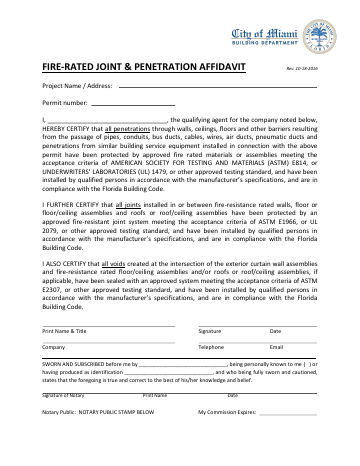
This affidavit certifies that all penetrations through fire-resistance rated barriers—from pipes, ducts, cables, and similar equipment—have been sealed with approved fire-rated materials meeting ASTM E814, UL 1479, or equivalent standards. It also confirms that fire-resistant joints in walls, floors, and roof assemblies meet ASTM E1966 or UL 2079 standards, and that exterior curtain wall voids are sealed per ASTM E2307. The affidavit must be signed by a qualifying agent and notarized to verify compliance with Florida Building Code requirements.
Who needs it
General contractors, mechanical engineers, or construction project managers certifying that fire-rated building systems meet code during new construction or renovation projects.
Why it needs a notary
This affidavit requires notarization because it is a sworn statement in which the qualifying agent certifies under oath that all fire-rated systems comply with Florida Building Code and approved testing standards.
How to get this notarized
- 1
Prepare Your Affidavit
Complete all sections of the Fire-Rated Joint & Penetration Affidavit. Ensure all project details, compliance statements, and signatory information are filled out accurately. Do not sign the document yet.
- 2
Gather Identification
Retrieve a valid, government-issued photo identification (e.g., driver's license, passport) that is current and matches the name on your affidavit. This is required for the notarization process.
- 3
Schedule Notary Appointment
Book an appointment with City Notary in Miami. We offer convenient scheduling options to fit your project timeline. Specify that you need a document notarized for construction compliance.
- 4
Meet Your Notary Public
Present your unsigned affidavit and valid ID to the notary. You will sign the document in the notary's presence. The notary will then verify your identity, witness your signature, and affix their seal and signature.
- 5
Submit the Notarized Affidavit
Once notarized, your Fire-Rated Joint & Penetration Affidavit is ready for submission to the relevant city department or authority in Miami, ensuring your project meets code requirements.
Preview the form
The blank PDF straight from Miami. Look it over, then upload your filled copy to start the notary session.

You’ll need ID and a webcam.
A licensed Florida online notary will join you on video, verify your government-issued ID, witness your signature, and apply their seal. You’ll receive the notarized PDF by email when the session ends.
Frequently asked questions
- What is a Fire-Rated Joint & Penetration Affidavit?
- This affidavit is a sworn statement affirming that fire-rated materials and assemblies in a building, specifically for penetrations and joints, comply with Florida Building Code and approved testing standards like ASTM E814 or UL 1479.
- Do I need notarization for a Fire-Rated Joint & Penetration Affidavit in Miami?
- Yes, notarization is required because this document is a sworn statement. The qualifying agent must certify under oath that all fire-rated systems adhere to Florida Building Code and relevant testing standards.
- Who typically needs to complete this Fire-Rated Joint & Penetration Affidavit?
- General contractors, mechanical engineers, or construction project managers in Miami are usually responsible for completing and submitting this affidavit, especially during new construction or renovation projects.
- How do I get my Fire-Rated Joint & Penetration Affidavit notarized in Miami?
- You can get your affidavit notarized by scheduling an appointment with a Florida Notary Public through City Notary. Ensure the document is fully completed but unsigned before meeting the notary, and bring a valid government-issued ID.